You are the marketer who spent three weekends on a portfolio that got opened twice. That is not a discipline problem and it is not a taste problem. It is an attention problem: the person reviewing you is choosing between dozens of applicants in one afternoon, and your best work sits below a fold they never reach. So here is the number almost nobody quotes. Sixteen hiring managers, 243 applications, and 55 seconds to read the resume, the portfolio and the cover letter before deciding whether to interview. Which of your three pieces survives 55 seconds? If you cannot name it, neither can they. And the pages ranking for this search will not tell you, because they are busy showing you how portfolios look.
You followed the portfolio advice to the letter: a clean landing page, a case study or two, a short bio, a contact link. Then you sent it and heard nothing, which is the part nobody writes about. Here is what I think is actually happening. Nobody rejected your work, because nobody read your work closely enough to reject it. A reviewer gives your portfolio a fraction of the attention you gave it, and the first thing they open is usually not the piece you spent three weeks finishing. That is a habit formed by volume, not a judgment about you. So which piece in your portfolio would survive a reviewer who never scrolls past the first screen? Much of the portfolio advice in circulation comes from people who have never had to choose between eighty of them in one afternoon, and the numbers that describe what a reviewer actually does are not in any of it.
Your portfolio is being read by someone who has already seen forty others today, and the decision is close to made before they open yours. That sounds like an excuse, so here is the number. Eye-tracking research on the initial resume screen, the study behind the familiar seven-second claim, puts the reading window at six to eight seconds. About 80 percent of that attention lands on six fields: your name, your current title and company, your previous title and company, your role dates, and your education. A portfolio that opens with a paragraph about your approach spends that window on the part nobody is scoring. This is a look at marketing portfolio examples the way the reviewer sees them, by what the work proves rather than how the page looks.
What a Reviewer Opens First (and What They Never Open)
The order is predictable once you know what the reviewer is trying to settle. They open your work samples before your bio, because the work is the only part that cannot be faked in a paragraph. Inside the samples, they look for three things in the first few lines: what you owned as opposed to what your team shipped, what number moved, and over what period. If none of those is visible, they move on.

Here is what stays closed. The third item on the page. The about section. The list of certifications. The downloadable deck nobody asked for. That is not laziness. A reviewer with a shortlist of ten has roughly one minute per candidate to decide whether to interview at all.
They open | They skip |
|---|---|
The first two work samples, in the order you placed them | Everything below the second item |
The outcome line under each sample | Paragraphs describing your approach |
Your scope: owned, led, supported | Tool lists and certificate grids |
One contact route | A long bio with no work in it |
The numbers behind that behavior come from more than one place, and it is worth saying which of them are large. The six-to-eight-second screen comes from eye-tracking work published through Boston University, and it is the largest of these studies. A portfolio evaluation study from Presentum put sixteen hiring managers against 243 applications and measured 55 seconds to review a resume, a portfolio and a cover letter together and decide whether to interview. Sixteen managers is a small sample, so treat 55 seconds as directional rather than exact.
What is not small is the volume. BambooHR's 2026 analysis of roughly 72 million applications found applicants per posting nearly doubled from about 46 in 2021 to 95 in 2025, while the hiring rate fell from 4.5 percent to 2.8 percent. Time from posting to hire rose 65 percent in three years, from 29 days to 48. A third of open roles in 2025 were never filled. Meanwhile Monster's 2026 State of Resumes Report, a survey of 1,001 US job seekers, found only 12 percent include a portfolio at all, and 68 percent spend under 30 minutes tailoring any given application.
One more number, with its flaw attached. A Hover survey of 121 people involved in hiring found 71 percent agree that a portfolio's quality influences their decision. The sample is small and skews toward people who already own a domain, which is what the survey company sells. Direction, not benchmark.
Put those two pictures together and you get the strange shape of this market. Applications doubled. Attention did not. The portfolio is the only artifact in your application a reviewer can evaluate without reading a word, which is exactly why it earns the two seconds it gets. Only about one in eight applicants brings one. If your title involves a measurable output, that is your opening, and it explains why the marketing analyst salary ladder prices evidence-heavy roles the way it does.
Six Portfolio Examples, Judged on Outcome
The pages ranking for this search mostly show you other people's portfolios and describe their color choices. That is not useful to you, and reproducing someone else's page is not something I am going to do here. Instead, here are six examples of marketing portfolio work described as a reviewer would read them, each judged on the result it proves rather than the layout it sits in. I have written them as briefs you can build from, not as screenshots to copy.
Each one follows the same test. Can the reviewer extract, without scrolling twice, what you owned, what changed, and how it was measured? If the answer is no, the design is irrelevant.
The SEO portfolio
An SEO portfolio is judged on movement against a baseline someone else could check. Name the query set, the starting position, the ending position and the date range. Then add the decision behind it: the page you chose not to touch, the internal link you added, the content you cut. A reviewer reads a rank improvement as a claim, and the decision as evidence you understand why it moved. Numbers first, method second, tooling last. If you ran a documentation-led program, the Google data analytics certification path covers the measurement literacy reviewers expect you to already have.
The brand and creative portfolio
Brand work is judged differently from performance work, and applicants rarely adjust for it. Here the reviewer is reading for consistency under constraint: the same voice across a campaign page, an out-of-home placement and a launch email, all shipped inside a legal and budget limit you can name. Outcome takes the form of recognition or reach, often shared with a team, so state your share honestly. A brand piece that hides the constraint reads as decoration. The marketing portfolio template you picked does not change this. What you attach to each piece does.
The lifecycle and email portfolio
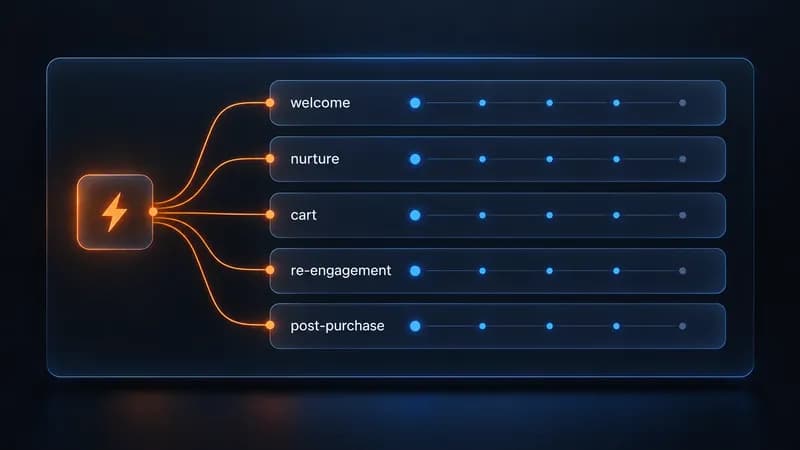
Email marketing portfolio examples live or die on segment logic. Show the list size, the trigger, the sequence and the metric that moved, whether that is revenue per send, click rate or reactivation. A screenshot of a pretty email proves you can design one. A before-and-after flow with send volume and the increment proves you can run a program. Say which part of the lift you can attribute and which you cannot.
The social media portfolio
Social media marketing portfolio examples move faster than any other category, because the numbers decay within weeks. That changes what a reviewer looks for: cadence, platform-specific adaptation, and whether you can tell a format that performed from one that merely got posted. Date every screenshot and name the account's size at the time. An engagement rate from an unstated follower count means nothing. A trend you joined early, with the reaction it produced and the date, means a great deal.
The content and copywriting portfolio
Content marketing portfolio examples need a different shape again, because the writing is only half the evidence. Show the brief you were given, the draft that came out of it, the edit the client made, and what the piece did after publication. It is a long chain, and that is the point. A reviewer hiring for content wants to see that you can work inside someone else's strategy, not only write well in your own. If the piece ranked, say against what. If it converted, say into what.
The digital and performance portfolio
Digital marketing portfolio examples are the easiest to prove and the easiest to fake, which is why reviewers read them skeptically. Lead with spend managed, cost per acquisition movement and the timeframe. Then include the thing most applicants leave out: what you killed and why. A campaign you shut down after three weeks shows judgment in a way a successful one rarely does. Name the channel mix and own the trade-off you made between volume and efficiency.
Whichever of the six you pick, connect it upward to the number your target role is judged on. The marketing KPIs breakdown maps the metric each seat owns, which is the fastest way to check that your proof matches the job you are applying for.
The Three Items That Make a Portfolio Look Amateur
Not the design. These three, in order of how often they appear.
A result with no number attached. "Increased engagement" and "grew organic traffic" are claims, not evidence. A reviewer cannot compare a claim to a requirement. Replace it with a figure, a baseline and a period, even if the figure is modest. A 12 percent lift inside a named timeframe outperforms an unquantified success story every time, because one can be checked and the other cannot.
Team work described as personal work. Two paragraphs about what the company achieved, with your contribution unnamed, tells the reviewer you either did not own it or do not understand scope. Write the split: what you decided, what you built, what someone else did. Reviewers hire for the part of the sentence that is yours.
A screenshot with no frame. A dashboard image with no date, no account size and no context is decoration. The reviewer cannot tell whether that curve is your best month or your average, and an unsourced graph reads as borrowed. Date it, size it, caption what it shows.
How to Show Work You Cannot Share Publicly
Agency and in-house work usually sits under an agreement, and a surprising number of applicants solve this by showing nothing and apologizing. The reviewer does not need the file. They need the reasoning.
Four workable substitutes, in descending order of strength. A method memo: two pages describing the problem, the constraints, the decision and the measured result, with absolute figures replaced by percentages and a stated index baseline. A redacted artifact: the real document with client names, budget lines and account identifiers removed. A rebuilt case: a past brief retold with your strategy re-argued from scratch against public data, clearly labeled as a reconstruction rather than the original. A named reference who can confirm the outcome in one call.
What a reviewer will not accept is a vague allusion to confidential client work as proof of anything. "I cannot show it, but it performed well" is the weakest sentence in any portfolio.
What to Put on the First Screen
Hold the first screen to the six-to-eight-second test, because that is the window you have.
Above the fold, in this order: one line naming the role you are applying for, three selected pieces with an outcome figure under each, one line stating your scope across them, and one contact route. That is it. Job title, proof, scope, contact. If a reviewer can extract those four things without scrolling, the portfolio has done its job and everything below is a bonus.

Three consequences worth accepting. Order your samples by relevance to the role, not by date. Put your strongest piece first, because the third item is rarely opened. And cut the count, because a reviewer who sees nine items assumes none of them are strong.
One more thing about the numbers on this screen. The same job market that doubled its applicant volume is short of provable experience, not of applicants: a 2026 hiring statistics compilation from National University reports 69 percent of employers struggling to find qualified candidates, with 50 percent naming lack of relevant experience rather than pay as the main obstacle. Your first screen is where that shortage meets your evidence. The social media manager salary and SEO specialist salary pages show what the proof is worth once it lands, and the marketing manager salary band shows the rung where scope starts to matter more than output.
Frequently Asked Questions
What should a marketing portfolio include?
Three to five pieces, each with a stated scope, a measured outcome and a date. Add one line at the top naming the role you want and one contact route. Anything without a number attached is filler, and a reviewer will read it as such. If you hold a senior title, the director of marketing salary band is priced on team scope, so your portfolio should show the same thing.
Do I need a website or is a document enough?
A document is enough in most applications, and it is preferable when a link would sit behind a login. What matters is that the reviewer reaches your proof in one click and without a download prompt on mobile. A personal site helps when your work needs to be seen in context, and hurts when it makes the same three pieces harder to find. Choose whichever gets the reviewer to the numbers faster.
How many pieces is too many?
More than five for most roles, and more than three if any of them is weak. A reviewer spends under a minute on the whole decision, so every additional piece dilutes the attention available to your best one. Cut until removing anything else would weaken the case. Then stop. The same discipline applies to a content strategist salary application, where a hiring manager is looking for judgment about what to leave out as much as about what to make.
Conclusion
The field serving this query is split between galleries of good-looking portfolios and build guides about structure, and neither tells you what a reviewer does in the 55 seconds they spend. There is a sharper version of that gap. Google's own generated answer to this query asserts that a portfolio beats a resume because it shows results rather than claims, and then cites thirteen sources, every one of them a gallery of portfolios or a guide to building one. The assertion has no evidence under it. That gap is why the evidence here matters more than the layout advice. The reviewer opens your work, looks for scope and a number, and leaves. Everything you build should serve that minute.
Here is the version I would act on this week. Take your current portfolio and write one outcome line under each piece, with a figure, a baseline and a period. Cut anything that cannot carry one. Then read the first screen out loud and time yourself. If you cannot state the role, the proof and the contact route inside eight seconds, neither can the person deciding whether to interview you.

For the evidence half of that work
If the harder part is producing the numbers before you can put them in front of anyone, that is what Allable.ai is built for: keyword research, campaign work and reporting in one workspace, so the figures on your first screen are ones you can show rather than ones you promise.